What is Tempo?
Tempo is a key concept that I’ve noticed a lot of new players take a while to grasp.
You can’t ignore it, because you will come across it in most, if not all, TCGs, and understanding it generally gives you the ability to know whether you’re in a winning or losing position at any moment, and adjust accordingly.
Online you can find different resources on the general concept, but I wanted to focus on OPTCG in particular, because in this game, more than in others, I find it fascinating and worth a deeper explanation and discussion.
Tempo is generally defined as the momentum a player is generating during the game, although its definition is often strictly tied to the context where it’s being discussed (i.e. what tempo means in one game can be quite different from what it means in another).
I learned about it when I was playing Hearthstone, which is a very tempo-oriented game where, if you lose control of the board, the game will easily snowball against you, and I soon found that the same reasoning applies to OPTCG too.
Tempo can be measured by looking at the state of the game: which player has more cards on the board? Which player has more cards in hand? Which player has more life? Whose turn is it? The player who comes out ahead on most of these questions usually holds the answer.
The player who is far ahead in these resources is usually the one with more tempo: more card advantage means more possible actions, more ability to defend and more chances to claim the initiative.
Gaining Tempo means making a play that either puts you far ahead in terms of card advantage, or forces your opponent to stop following their own plan. Instead of playing proactively, they have to react to your threat, and reacting is often less efficient: think of an opponent forced to attach Don!! to remove one of your threats, instead of using them to develop one of their own.
The easiest example of a tempo positive play in OPTCG is attacking a rested character: our opponent either chooses to defend it by giving up a counter card from hand, or lets it die. Either way, they lose a card (from hand or from board).
A tempo neutral play is, for example, playing a character: your hand size decreases by one, but now you have one more card on your board.
A Rush character, instead, is more often than not a tempo positive play: it attacks immediately, so it always asks your opponent for a card (unless they just take a life, which is not always a tempo positive play in the early stages of the game).
Life cards are how you win or lose the game, sure, but losing a life is not always a bad thing: every life card you lose goes to your hand, so it’s one more card for you. That’s why a different way to play for tempo is starving your opponent, which means not giving them life cards when they need resources: instead of attacking the leader, you attack their characters, and they get nothing back.
Cards that have an immediate impact on the board are usually tempo positive. Let’s see some easy examples:
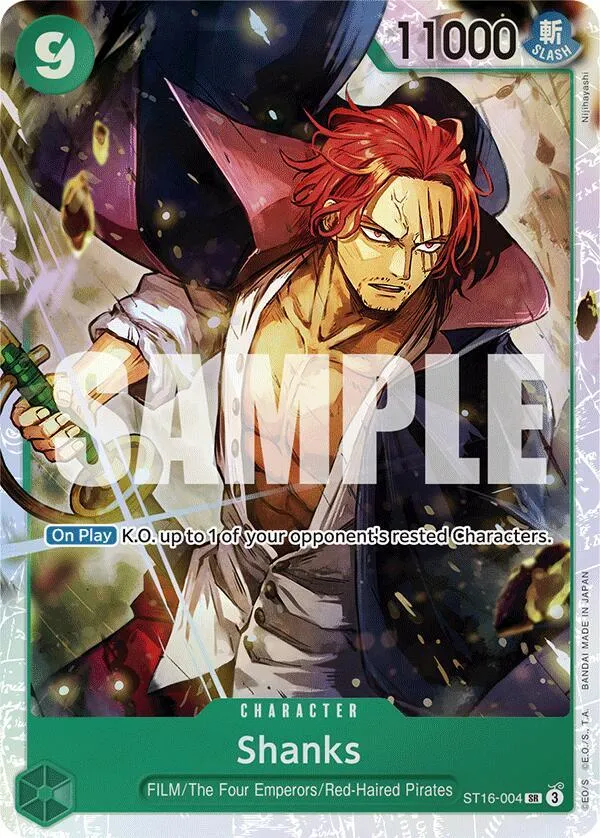
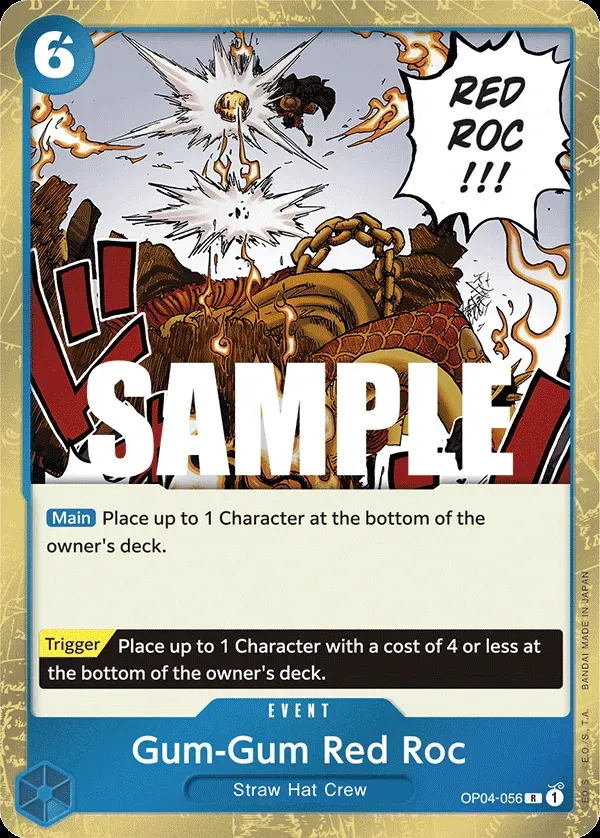
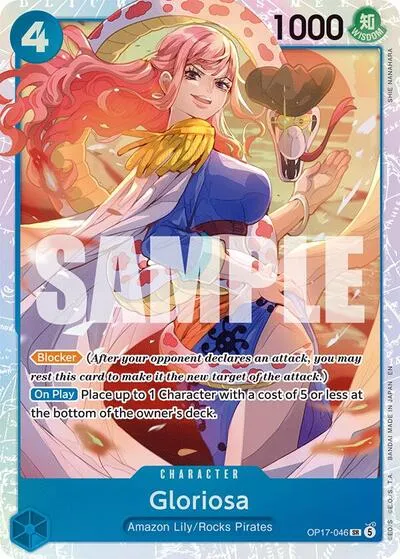
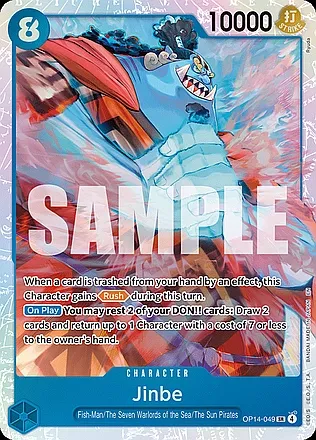
| Card | You | Opponent | Tempo |
|---|---|---|---|
| ST16 Shanks (9 cost, Green) | +1 | −1 | Positive: develops a big threat and removes (potentially big) one |
| Gum-Gum Red Roc (rotated) | −1 | −1 | Usually neutral |
| OP17 Gloriosa | +1 | −1 | Slightly positive: removes 1 for your opponent, but you only develop a small blocker |
| OP14 Jinbe (full effect) | +1 | −1 or more | Insane: you go −1 but immediately draw 2 back, so effectively +1 (while cycling); your opponent goes −1 on board and then faces a 10k Rusher that will demand at least 2-3 cards to counter, or straight up losing another character (−1) or a life |
(I think you can tell I played a lot of Jinbe/Rocks lol)
Those are pretty straightforward tempo plays, but there is an enormous amount of intricacies in this game that are not easy to spot, like when to pivot to the board and start starving your opponent (e.g. when they free block while high on life but low on hand size), and when to stop and start pushing for lethal. Those are better learned with IRL examples, which I will provide in future articles.
Making plays that optimize your tempo should bring you closer to victory or, to put it better, the player who falls too far behind on tempo will inevitably head towards defeat if they can’t recover. Hence, a tempo negative play is usually a misplay.
That’s why tempo is an essential fundamental to grasp in OPTCG. The colors best suited to practice it are Blue, Red and Green (or old removal-heavy Black decks like Lucci), but it’s an inevitable core concept of this game that you will have to reason about with every deck, even if you ignore its existence (and that’s what makes me love this game so much).
Skilleglyph
“Yeah, I’ll get right on it,” burned the first,
“Is this really necessary?” it sighed;
“Why do you call?” the shadow cursed,
yet “as you command” it stood beside.
“Put this apple on your head!” “Hey, catch!”
and knives flew forth with every friend;
“I feel icky!” “Gimme a big hug!” No match,
they bit the foe e’en at their end.
“From the void I come!” “Who dares summon me?!”
Each turn, a little more, a little new;
the board was ours ere thou couldst see.
“A paltry task,” quoth all the Zoo.